



Chinese short dramas are blowing up everywhere, some clips are hitting 500M+ views on YouTube Shorts. Within the global landscape of the short drama market, Chinese short dramas hold immense potential. They're fast, addictive, and packed with emotion. But there's one big problem: most of the best ones don't come with English subtitles. If you've ever thought, "This looks amazing… but I have no idea what they're saying," you're not alone.
The good news is you can translate Chinese short dramas yourself, and you don't need to be fluent or have fancy software. This guide walks you through four proven methods, how to handle the parts that trip up most tools (tones, idioms, honorifics), and how to make your translations sound natural instead of robotic.
Written by the C-Drama Subtitles team. We subtitle Chinese short dramas across TikTok, YouTube Shorts, and Bilibili—covering CEO romance, xianxia, and historical genres. We tested every tool in this guide on actual clips in 2026, including scenes with overlapping dialogue, classical Chinese, and heavy internet slang.
Quick Answer: Best Method for Your Situation
Most decisions come down to content type and how much accuracy matters for a given clip:
- Quick audience test → YouTube auto-translate — free, instant, good enough to gauge interest before investing
- Most creators → Mediaio Video Translator — handles modern dialogue well, fast turnaround, affordable at $1/min
- Xianxia / historical dramas → AI + native speaker review — classical Chinese and cultivation terms need human judgment
- Licensed / official releases → Professional service — Viki, Rev, or Gengo for certified, broadcast-ready output
Full step-by-step instructions for each method are below.
4 Methods to Translate Chinese Short Dramas
Method 1: AI-Powered Translation Tools - Recommended for Most Creators
- $10–30/month
- 10–15 min per clip
- Best tools: Mediaio, CapCut
AI tools handle modern C-drama dialogue well. In our tests on CEO romance and urban drama clips, Mediaio Video Translator correctly adapted most common idioms and maintained the emotional register of heated arguments. CapCut is the better starting point if you're already on TikTok, it's free and the workflow is familiar. Where AI consistently struggled: classical Chinese in historical dramas, rare dialect expressions, and jokes that rely on wordplay (谐音梗). Those need a human pass.
Step-by-Step: Translating a C-Drama Clip with Mediaio
Export your Chinese short drama clip in MP4 or MOV format. Before uploading, check two things: first, that the audio is clean—AI transcription accuracy drops significantly when background music is mixed into the dialogue track at high volume, so strip or reduce the music track if possible. Second, note whether the drama uses Simplified or Traditional Chinese characters, as this affects source language detection.
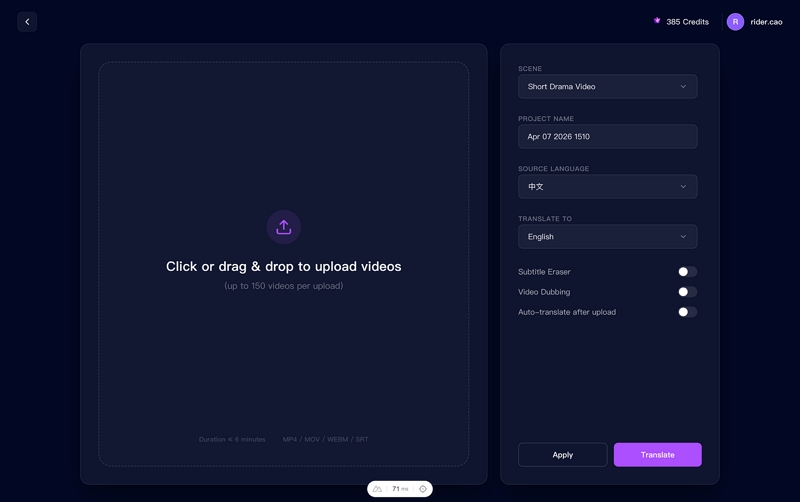
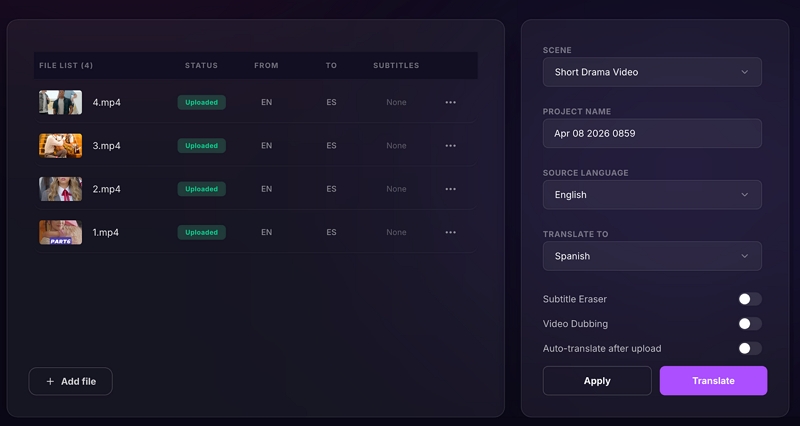
After upload, set your source language to Chinese (Mandarin or Cantonese) and choose your target language. For drama content, select Cultural adaptation mode rather than Standard—this instructs Mediaio to adapt idioms and emotional register rather than translate literally. You can also enable optional features at this stage:
Voice dubbing: AI recreates emotional tone in the target language; particularly effective for romance and CEO drama scenes where tone carries as much meaning as words
Subtitle removal: strips any hardcoded Chinese subtitles from the source before processing, useful when working with pre-subtitled drama clips
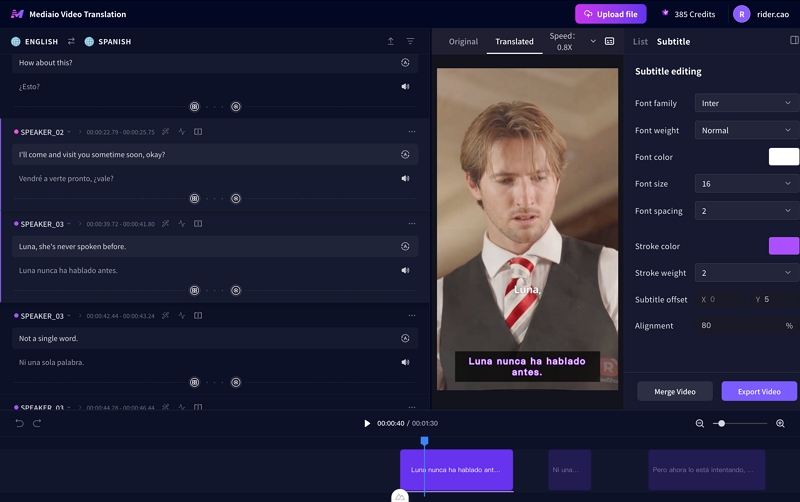
Processing takes 5–10 minutes. Once complete, Mediaio opens an inline editing interface where you can review every subtitle line. For C-drama content, focus your review time on three areas: emotional peaks (confession scenes, arguments, plot reveals), character address terms and honorifics, and any lines flagged by Mediaio's idiom detection. Check the quality checklist in Part 5 of this guide before finalizing—it's faster than watching the whole clip through again.
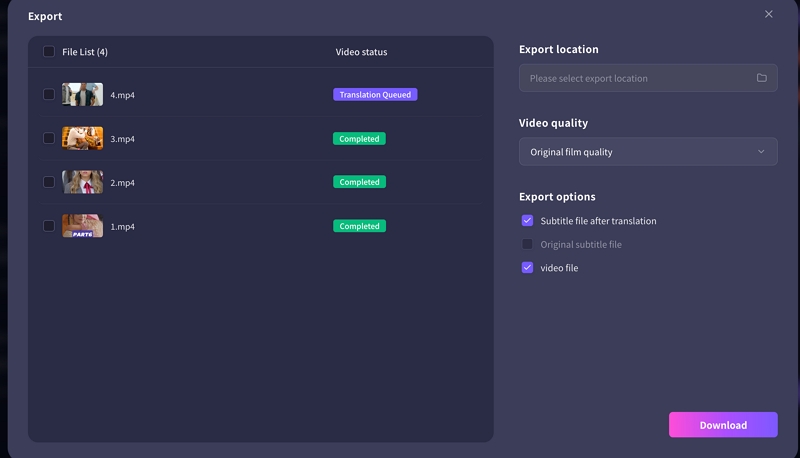
Choose your output format based on where you're publishing: SRT/VTT files for YouTube (upload via YouTube Studio → Subtitles → Add language → Upload file); burned-in subtitles for TikTok and Instagram Reels, which don't support external subtitle files. Before posting, watch the exported clip on your phone. Subtitles that read clearly on a desktop often appear too small or overlap on mobile—use white text with a black outline, and aim for no more than 35 characters per line.
Method 2: YouTube Auto-Translate — Free Audience Testing
- Free
- Instant
- 100+ languages
If you just want to test whether your Chinese short drama has global potential, YouTube's auto-translate is the quickest way to get subtitles in multiple languages. It's not accurate enough for Chinese idioms and emotional dialogue, but it's fast, free, and useful for gauging audience interest before investing in a proper translation workflow.
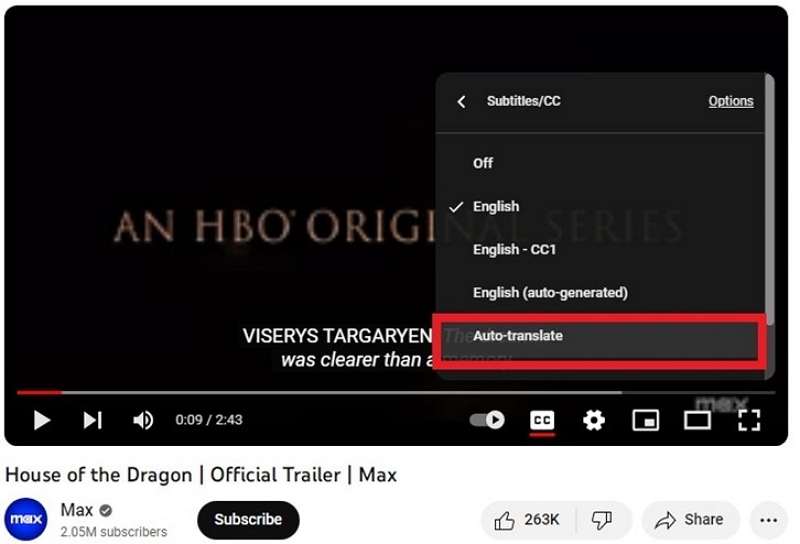
- Upload the clip to YouTube (public or unlisted). YouTube auto-generates Chinese captions within a few minutes—this step is required before translations become available.
- Enable auto-translate in YouTube Studio → Subtitles → select video → Auto-translate → choose target language(s).
- Publish. Viewers can pick languages from the CC menu across desktop, mobile, and TV apps.
Typical mistakes we saw in testing:
- "他吃醋了" → "He ate vinegar" (should be "He's jealous")
- "老板" → "Boss" (should be "CEO" in romance context)
- "面子" → "Face" (should be "reputation/dignity")
When to use it: Use YouTube auto-translate as a zero-cost test to see if a drama attracts viewers from other countries before investing in a proper translation. Don't publish it as your final product.
Method 3: AI + Native Speaker Review — Best for Historical and Xianxia Content
- $20–50 per video
- 1–2 days
Run the clip through Mediaio first to get a working draft, then send it to a native Chinese speaker for a focused review. On Fiverr you'll pay $15–30 for someone to spend 1–2 hours on a short clip. This combination is what we use for xianxia and historical content where AI alone misses too much—classical terms, cultivation hierarchies, and jokes that rely on wordplay that no current model handles reliably.
- AI translate with Mediaio (10 minutes) — gets you 90% of the way there on modern dialogue and common idioms.
- Native speaker review (1–2 hours) — focus the reviewer on idioms, honorifics, emotional scenes, and any cultural references a Western audience might not understand. Provide context: the drama genre, character relationships, and a list of terms you're unsure about. Ask specifically: Are honorifics reflecting the right relationship dynamic? Are any idioms still literal? Are there cultural references that need a one-line gloss?
- Final edit (30 minutes) — verify subtitle timing, adjust line length for mobile readability, and run the quality checklist in Part 5.
Best for: monetized YouTube channels, historical dramas with complex language, xianxia with cultivation terminology, comedy where jokes need cultural adaptation rather than literal translation.
Method 4: Professional Translation Services — Licensed and Official Releases
- $100–500 per video
- 3–7 days
- Platforms: Viki, Rev, Gengo
For official releases, licensed content, or anything going through a distributor. Viki has community translators with deep C-drama expertise; Rev and Gengo offer certified output for legal and marketing use. Not practical for independent creators posting daily, but the right call when the stakes are high enough that a mistranslation has real consequences.
Side-by-Side Comparison
The Cultural Layer: What Tools Can't Do Alone
This is where most translations break down. Chinese short dramas carry layers of cultural meaning that don't survive a word-for-word swap. These are the five challenges that come up most often, with real examples from our testing.
1. Idioms (成语) — Translate the Meaning, Not the Words
Four-character idioms carry compressed meaning that's completely opaque if translated literally. Here are examples we encountered in actual clips:
Build a running idiom glossary as you work through a series. The same expressions recur constantly in CEO romance and family drama genres—once you've decided on your adaptation, keep it consistent across all episodes.
2. Relationship Titles and Honorifics
Chinese has precise terms for relationships that English collapses into vague words. Getting these wrong breaks character dynamics entirely.
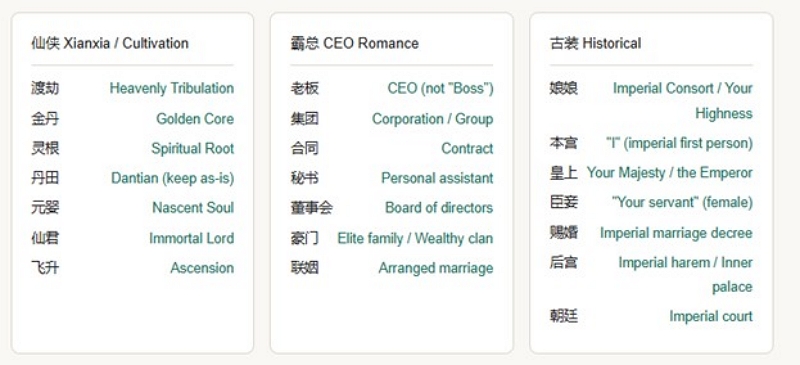
3. Genre-Specific Vocabulary
Each genre has its own vocabulary ecosystem. Fans expect consistency—using "Golden Core" in one episode and "Gold Elixir" in the next will get called out in comments immediately. Establish your terminology in episode one and document it.
After Translating: The Quality Checklist
Don't review your translation by watching the whole clip through again, you'll miss things. Work through these specific checks instead:
1. Do emotional peaks land with the right intensity?
Pick the three most dramatic moments. Read the subtitle out loud. Does it still feel tense, sad, or angry—or has it flattened into neutral?
2. Are relationship dynamics preserved?
Check how characters address each other. Formal speech between rivals should stay formal. Intimacy should feel intimate, not polite.
3. Have any idioms come out literally?
Search your subtitle file for common red flags: "vinegar," "face," "feet," "door." These often signal a literal idiom slip-through.
4. Are genre terms consistent with earlier episodes?
If you called it "Golden Core" in episode one, it should not become "Gold Elixir" in episode three. Keep a glossary doc open while you work.
5. Do subtitles clear the screen before the next line starts?
Watch on your phone, not your monitor. Subtitles that feel readable on desktop often overlap on mobile—aim for no more than 35 characters per line.
6. Does a non-Chinese viewer understand every cultural reference?
Concepts like face (面子), Spring Festival timing, or lucky numbers may need a one-sentence gloss on first use—but only when they affect the plot.
FAQs
None of them handle it reliably. Modern AI translation tools are trained primarily on contemporary Mandarin. For 古装剧 with significant classical dialogue, the AI + human review method is the only viable option. Use Papago as a starting-point reference for the translation draft, then bring in a human reviewer who specializes in historical Chinese content.
Keep the romanized pronunciation (pinyin) for names—don't translate them. Translate titles and address terms contextually. "李总" becomes "CEO Li," not "Li Zong." Add a brief role label on first appearance: "(Ming — CEO of the Tianlong Group)" and then just "Ming" afterward.
This usually traces back to the audio track. AI timing is calculated from speech detection—if background music is mixed in at high volume, the tool struggles to find sentence boundaries accurately. Reduce or strip the music track before uploading to Mediaio, or use VEED.io's subtitle timeline editor to shift all subtitles as a block after generation.
Most AI tools handle common slang well, but very recent viral terms may be missing from training data. Check Weibo or Douyin for context on unfamiliar terms and adapt manually in Mediaio's review interface before exporting.
It depends on your target audience. Spanish and Portuguese audiences prefer dubbed content—retention is measurably higher. English-speaking C-drama fans often prefer original audio with subtitles. Test both formats on top-performing clips before committing to one approach across your channel.
Conclusion and Next Steps
For most Chinese short drama creators, the practical starting point is Mediaio for everyday modern clips, with a human review pass reserved for emotionally critical scenes and any historical or xianxia content where the language complexity exceeds what current models handle reliably.
The cultural layer—idioms, honorifics, genre vocabulary—is where the real work happens, and also where the payoff is largest. A translation that preserves the emotional rhythm and relationship dynamics of the original will always outperform one that's technically accurate but tonally flat.
Start with one clip, one method, and one target language. Watch how your audience responds. Then scale what works.