



Imagine you’re on a short break and don’t have time to watch a full movie. What would you do? Scroll through your mobile and enjoy a short drama instead. Yes, you’re not alone. Most of us do that. Short dramas have taken over our screens as they offer a quick entertainment fix.
Why do short dramas succeed?
These mini-series succeed because:
- The highly engaging, concise storytelling: episodes last a minute or two,
- They dive into the action almost immediately without any filler,
It's a fresh, addictive way to enjoy stories on the go, and it's changing how we watch video. To understand this rapid transformation, let’s first discuss why the short drama market is growing at such a fast pace.
Why Is the Short Drama Market Growing?
The rapid growth of the short drama market is driven by changing viewing habits, lower production costs, and expanding global opportunities.
1. Changing Consumer Behavior
People increasingly prefer short, mobile-friendly videos that fit into busy schedules. Short dramas provide quick entertainment anytime and anywhere.
2. Low Production Barrier
Short dramas cost less and take much less time to produce than traditional TV shows or movies. This allows creators to publish new content more frequently.
3. Global Localization Opportunity
Successful short dramas can be easily adapted for different countries through translation and local production. This helps creators reach global audiences and expand into new markets.
Global Short Drama Market Landscape
If you think your friends are the only ones hooked on these rapid-fire shows, the latest data might surprise you. This style of entertainment has gone from a minor experiment to an absolute giant in the media world.
1. Global short-form drama market size and development trends in 2026
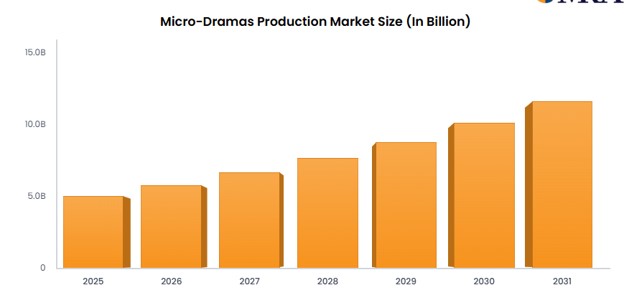
The global micro-drama market is experiencing rapid growth, with total revenue expected to exceed $11 billion. The production sector alone is projected to reach approximately $5.75 billion in 2026 and grow toward $10 billion by 2030, according to MRA. This rapid trajectory is supported by an impressive Compound Annual Growth Rate (CAGR) of 15% to 15.4%, propelled by a structural shift toward mobile-first, vertical video consumption and massive platforms like TikTok, Kuaishou, and Tencent.
2. Short-form drama markets across different global regions
Market share and size by region
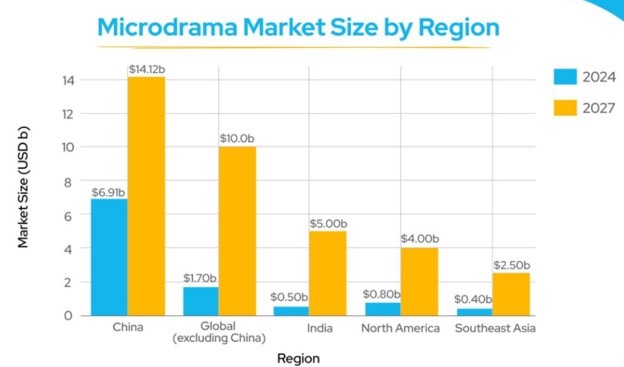
- East Asia (China leading): Remains the undisputed superpower of the industry, capturing a massive 83% share of total global revenue. China's domestic market reached $6.91 billion recently, making it larger than its national theatrical box office.
- United States / North America: Represents the largest international market outside of China, commanding 8.6% of total global revenue and an impressive 40% share of global short-drama app-specific revenues, backed by a mature entertainment ecosystem and strong user spending power.
- Southeast Asia & India: Serving as the primary engine for user scaling and downloads. India is the fastest-growing frontier, projected to leap from $0.5 billion to $5 billion by 2027 (a 900% explosion), while Southeast Asian nations like Indonesia and the Philippines report over 140% year-over-year download growth.
- Latin America & Europe: Emerging growth pockets with expanding footprints. Latin America (anchored by Brazil and Argentina) contributes a smaller but fast-scaling revenue slice, driven by cheap user acquisition costs and a massive, young mobile population.
Characteristics of different market regions
Here is a quick look at how different regions stack up right now:
Japan: Workplace and revenge dramas.
Korea: Sweet romance, reincarnation. Dominated by female viewers. Notably, APAC leads globally in older smartphone viewers (55+) adopting the format. High market concentration controlled by tech giants (Tencent, Kuaishou, iQiyi); highly sophisticated, rapid, industrialized pipelines.
3. New developments and trends in the short-form drama market
The short-form drama ecosystem is transitioning from a speculative, low-budget niche into a highly industrialized media segment characterized by three major waves.
- AI-driven cost reduction is reshaping production pipelines, with artificial intelligence lowering scripting, editing, and dubbing expenses by up to 75%.
- Platforms are shifting toward premiumization and genre diversification, leaving behind cheap, repetitive plotlines to produce calculated, high-quality portfolios covering untapped niches like period nostalgia and silver-haired (senior-focused) dramas.
- Monetization is evolving past rigid per-episode micropayments into a hybrid ecosystem combining free-to-watch tiers, monthly unlimited VIP passes, and social commerce integrations.
Understanding this crazy growth makes you realize why the industry is testing completely new short-form drama business models.
Short Drama Market Business Models
Short drama platforms mainly generate revenue through four business models. Many platforms combine multiple models to maximize user value and long-term growth.
Model 1: Paid Episodes
Users can watch the first few episodes for free, then unlock additional episodes with one-time purchases or in-app coins. This pay-per-episode model is widely used by platforms like ReelShort.
Model 2: Advertising
Free users watch ads between episodes to unlock more content. Some platforms also monetize through brand placements and sponsored content within dramas.
Model 3: Subscription
A monthly or weekly subscription gives users unlimited access to premium content without ads. This model creates recurring revenue while improving user retention.
Model 4: IP Expansion
Successful short dramas often expand beyond streaming into merchandise, games, books, licensing, and local adaptations, creating additional revenue streams from a single IP.
The rapid growth of these business models is increasing demand for faster and more cost-effective content production. As a result, AI is becoming an important tool for translation, dubbing, localization, and large-scale short drama distribution.
How AI Will Shape the Future of the Short Drama Market
As the short drama market grows, creators need faster and more scalable ways to produce, localize, and promote content. AI is becoming a key technology that helps studios expand globally while reducing production costs.
AI Localization
Localization is one of the biggest opportunities for short drama platforms. AI can translate dialogue, generate multilingual dubbing, preserve the original speaker's voice, and synchronize lip movements, making it easier to release the same drama in multiple markets.
Tools like Mediaio Video Translator streamline video localization by translating speech, preserving the original actor's voice and tone, and synchronizing lip movements across multiple languages. This helps studios launch localized content faster while reducing production costs.
AI Marketing
AI also improves marketing efficiency by automatically generating promotional assets, including:
- Trailers: Create multiple trailers from key scenes for different audiences.
- Short Clips: Convert episodes into social media clips with captions and vertical formatting.
- Video Ads: Generate and test multiple ad creatives to improve campaign performance.
AI Production Assistance
Beyond localization and marketing, AI helps accelerate production by assisting with script analysis, subtitle generation, audio enhancement, color correction, and other repetitive editing tasks. This allows creative teams to focus more on storytelling while reducing production time.
As AI continues to evolve, it is becoming an essential part of the short drama production workflow. Studios that adopt AI can produce content more efficiently, expand into global markets faster, and respond more quickly to changing audience demand.
Opportunities for Businesses Entering the Short Drama Market
The rapid growth of the short drama market has created opportunities across the entire content ecosystem. Depending on their expertise, businesses can participate in content creation, distribution, localization, or AI-powered services.
1. Production
Demand for short-form content continues to grow across streaming platforms and social media. Production companies that can deliver high-quality vertical dramas efficiently are well positioned to serve this expanding market.
2. Distribution
As more creators enter the market, demand for distribution services is also increasing. Businesses can build regional streaming platforms, license content, or help creators distribute dramas through social media and mobile apps. A global short drama distribution strategy is part of the growth strategy.
3. Localization Services
Global expansion is driving demand for translation, dubbing, subtitle localization, and cultural adaptation. Companies that help creators localize content for different languages and markets can support international distribution at scale.
4. AI Solutions
AI is creating new opportunities for software providers. Tools for video translation, voice cloning, subtitle generation, editing, and marketing automation can help creators reduce production time and improve operational efficiency.
Conclusion
The short drama market has officially changed how we consume video on our phones. By trading long TV episodes for fast-paced, highly engaging vertical clips, this mobile-first format has exploded into a multi-billion-dollar global industry. Driven by changing consumer habits and low production costs, it offers massive opportunities worldwide.
Businesses can thrive right now by jumping into production, distribution, or localization services. At the same time, tools like AI and Mediaio Video Translator are accelerating the way these shows are made and shared globally. It is clear that short-form storytelling is not just a quick-passing trend—it is completely defining the future of digital entertainment.