



A short drama that succeeds in one country may fail overseas, not because the story is bad, but because audiences cannot emotionally connect with the characters. Short drama localization is not just translation.
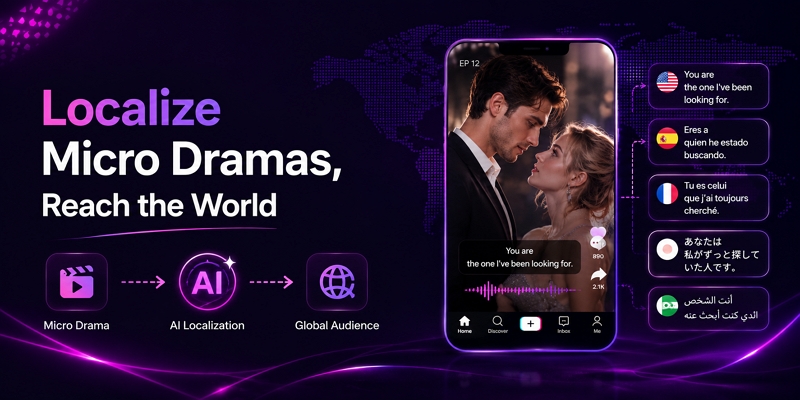
For creators expanding micro dramas globally, the challenge has evolved beyond simply accessing new audiences. But it is to ensure stories resonate across different languages and cultures while preserving emotions, character identities, and the original viewing experience.
In this guide, you'll learn how micro drama localization works, why it matters, the challenges involved, and practical ways to bring short dramas to global audiences.
What Is Short Drama Localization?
Short drama localization goes beyond translating dialogues. It adapts language, emotions, and cultural nuances so audiences across different markets connect with the story as naturally as the original viewers. It encompasses voice localization, subtitle optimization, cultural adaptation, and emotional preservation beyond simple translation.
For example, a Korean romance micro drama may lose its emotional depth through literal English translation.
According to TV Tech, viewers across 19 international markets spent 45% of their streaming time watching non-U.S. content in 2025, highlighting the growing importance of localization for global audience growth.
Translation vs Localization: Which Approach Works Better for Global Audiences?
Key Insights: A translated micro drama may be understandable to international viewers. A localized micro drama feels natural, culturally adapted, and emotionally authentic. It frequently influences whether viewers stay engaged or leave after the opening episodes.
Why Short Drama Localization Matters in Global Expansion
Global expansion is not just about translating short dramas. It retains the emotional impact and viewing experience that defined the original story’s appeal. For creators, effective localization is reflected in audience retention, emotional engagement, and overall platform performance.
1. Audience Retention
With their quick-consumption format, short dramas depend strongly on audience retention as a measure of global performance. When the story is clearly understood and emotionally felt, viewers are more likely to continue viewing.
2. Emotional Connection
Micro dramas rely heavily on emotions because stories unfold within a short duration. Localization helps preserve emotional depth and character relationships across different cultures.
3. Platform Algorithm Performance
Across TikTok, Instagram Reels, and dedicated short drama apps, content visibility is driven directly by audience behavior. Content that sustains engagement, encourages sharing, and reduces abandonment is more likely to be widely recommended.
Key Insight
Localization is not only a translation strategy. It determines how viewers watch, emotionally respond to, and engage with short dramas, making it vital for long-term global success.
The Complete Short Drama Localization Workflow
We have already observed how localization supports higher retention, deeper emotional resonance, and expanded global reach.
To see this in action, we tested the localization workflow on a Korean romance micro drama. While adapting it for English-speaking audiences, the original emotional impact was carefully preserved.
The workflow followed four key stages:
Script Localization → Subtitle Localization → AI Voice Translation & Dubbing → Quality Review
Step 1: Script Localization
Script localization was the foundation of the workflow because preserving emotions required more than translating dialogues. During evaluation, romantic conversations, emotional expressions, and culture-specific phrases were adapted to sound natural in English while maintaining the original tone and character relationships.
Key Observation: The localized script captured the emotions of the original story while ensuring that conversations resonated naturally with English-speaking audiences.
Step 2: Subtitle Localization
The next stage focused on subtitle localization, where readability and timing directly impacted the viewing experience. The evaluation prioritized mobile viewing, ensuring subtitles remained easy to read without distracting audiences from emotional scenes.
Key Observation: By improving readability, the optimized subtitles helped preserve the story's emotional pacing and viewer experience.
Step 3: AI Voice Translation & Dubbing
With the script and subtitles adapted, the next step was to localize the voice-over through translation and dubbing. Although traditional dubbing is still commonly used, AI dubbing was adopted in this workflow for its efficiency, scalability, and ability to provide uniform voice localization across an entire short drama series.
For this workflow, Mediaio Video Translator was selected as the AI dubbing framework because it combines voice translation, AI dubbing, and subtitle generation within a single interface. This streamlined the localization process while helping preserve character voices and emotional consistency across episodes. You can view the detailed steps here >>.
Key Observation: AI dubbing balanced efficiency and scalability with the preservation of emotional depth and character identity, making it well suited for short drama localization.
Step 4: Quality Review
The final stage focused on evaluating whether the localized version delivered an experience comparable to the original drama. The evaluation extended beyond language accuracy to examine emotional authenticity, natural pronunciation, and cultural relevance.
Key Observation: The localized version preserved the story's emotional impact while offering a natural viewing experience for global audiences.
Challenges of Localizing Short Dramas
Challenges of Localizing Short Dramas
Despite advances in AI, localization remains one of the biggest hurdles to global expansion. Creators must preserve character identity, localize large episode libraries efficiently, and maintain quality across multiple languages.
Maintaining Character Identity
Audiences connect with characters through their voices, emotions, and personalities. Poor dubbing or generic voice synthesis can weaken that connection. Successful creators use emotion-aware dubbing and consistent voice profiles to preserve the original character experience.
Scaling Large Episode Libraries
Many short dramas consist of dozens or even hundreds of episodes. Localizing scripts, subtitles, and dubbing at scale can quickly become a bottleneck. AI-powered workflows help creators process large volumes of content faster while maintaining consistency.
Balancing Speed and Quality
Fast localization is important, but quality cannot be sacrificed. Unnatural dubbing, inaccurate subtitles, or weak emotional delivery can reduce viewer engagement. The most effective localization strategies combine AI automation with human review to ensure both speed and quality.
AI-Powered Short Drama Localization: The Future Workflow
Successful short drama localization requires three things: preserving character identity, maintaining quality, and scaling efficiently across languages.
One solution is Mediaio Video Translator, which combines AI translation, dubbing, subtitle generation, and batch processing in a single workflow. By streamlining the localization process, it helps creators adapt short dramas for global audiences while maintaining a consistent viewing experience.
How to Translate Short Drama in Batch with AI
Step 1: Open Mediaio Video Translator, sign in, and upload all the short drama episodes you want to localize. Batch upload allows multiple episodes to be processed together, making it ideal for large series.
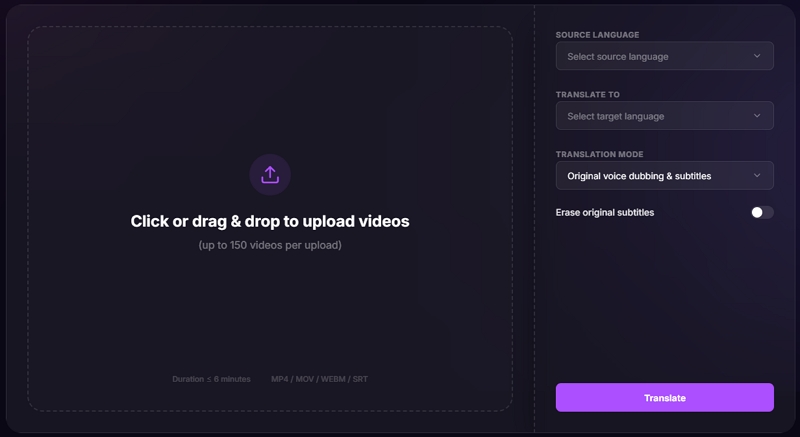
Step 2: Enter the project details, choose the source and target languages, and enable Video Dubbing. Once configured, click Translate.
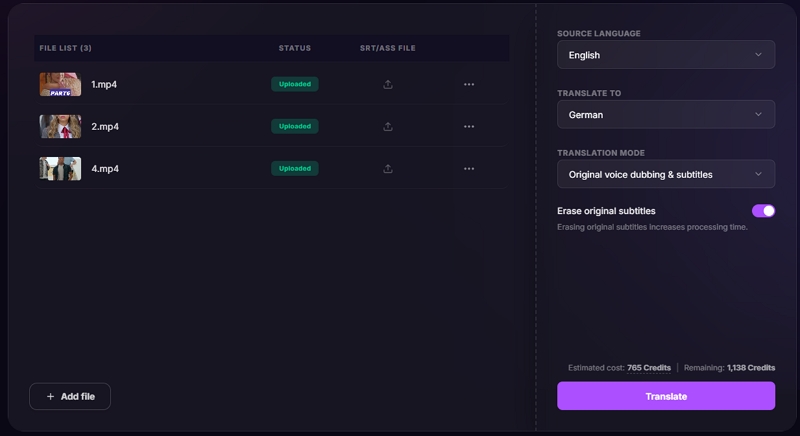
Step 3: When processing is finished, assess the translated videos and ensure subtitle quality and consistency. Readability and synchronization can be enhanced by adjusting subtitle style, timing, alignment, font, and color. You can modify the subtitle content to make it more localized, then redub it just by one click. The re-dubbing process requires no further editing. So easy!
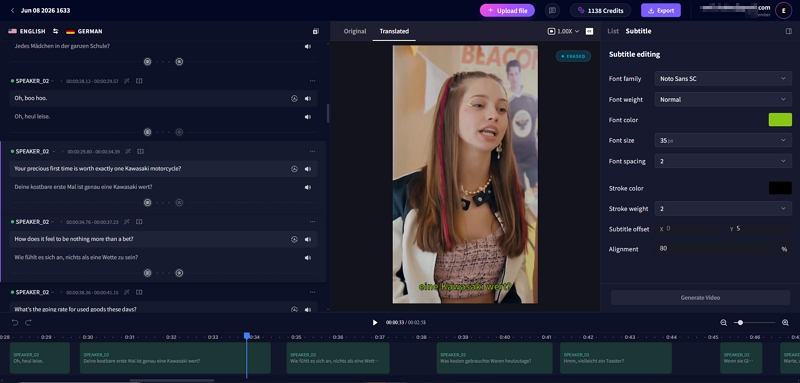
Step 4: When you’re satisfied with the final dubbing and subtitles, click Export. Choose the preferred output settings and download the localized episodes.
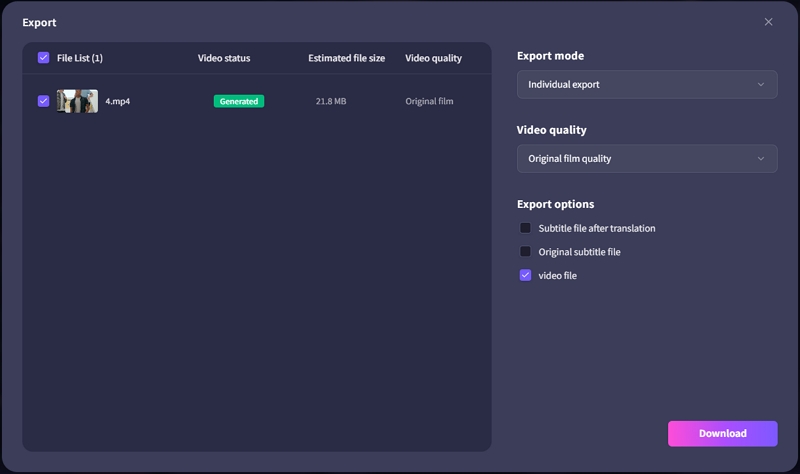
Our Insights: The batch workflow simplified the localization of multiple short drama episodes while keeping subtitles synchronized and maintaining a smooth viewing experience across languages.
Best Practices for Successful Short Drama Localization
Successful localization goes beyond translation. Use this checklist to review your localization workflow before publishing.
Quick Tip: Successful localization begins with an audience experience mindset. Short dramas are more likely to resonate globally when emotions, voices, subtitles, and cultural nuances align naturally.
Building a Global Future with Micro Drama Localization
In an increasingly global market, micro drama localization helps creators bridge language and cultural differences while preserving the essence of the original story. It goes beyond translation to preserve emotions, maintain character identity, and retain the original viewing experience.
AI-powered workflows and tools such as Mediaio Video Translator help creators streamline localization, scale across markets, and share stories globally without compromising the original narrative experience.